By minrry | 19 August 2026 | 0 Comments
MR604E Single Phase Repulsion Motor — Technical Blog
MR604E Single Phase
Repulsion Motor — Technical Blog
Repulsion Motor — Technical Blog
1. Product Introduction
1.1 Product Description
The MR604E Single Phase Repulsion Motor is a professional teaching and training device designed for electrical engineering and motor control education. It integrates a genuine single-phase repulsion motor with a comprehensive set of measurement modules, wiring terminals, conversion circuits, and protective components, enabling students to construct, operate, and analyze one of the most distinctive single-phase AC motor topologies.
A repulsion motor is a commutator-type single-phase AC motor that develops torque through the repulsion between the stator magnetic field and currents induced in the rotor winding. By adjusting the brush angle, trainees can directly observe how starting torque, running speed, and direction of rotation change — making the MR604E an ideal platform for understanding commutator motor principles, armature reaction, and speed regulation that cannot be easily demonstrated with ordinary induction motors.
1.2 Product Features
(1) Clear component layout, engineering-grade terminals.
The panel arranges the stator winding, rotor assembly, commutator, brush holder, measurement interfaces, and power terminals in a layout that mirrors real industrial motor control cabinets. Students can quickly complete wiring, debug the circuit, and strengthen practical skills — shortening the gap between classroom theory and hands-on operation.
(2) Integrated measurement and protection units.
The trainer incorporates voltmeters, ammeters, wattmeters, and a digital multimeter interface, covering experiments from basic no-load characterization to loaded performance and brush-angle adjustment. It supports the full teaching sequence: principle recognition, circuit construction, parameter measurement, and performance analysis, all on one station.
(3) Standard electrical design with safety compliance.
Component selection, circuit protection, insulation coordination, and emergency stop follow international electrical safety regulations. Necessary insulation barriers, overcurrent protection, and grounding measures reduce hazards during live training, providing a stable and safe experimental environment.
(4) Compact and portable.
The bench-top form factor minimizes floor space and allows easy relocation between classrooms, laboratories, and off-site training venues.
(5) Realistic industrial simulation.
The trainer reproduces the operating characteristics of historical and legacy repulsion-motor drives still found in elevators, hoists, compressors, and machine tools — giving trainees a close-to-real working environment for maintenance and troubleshooting practice.
(6) Systematic curriculum support.
Accompanying lab manuals cover fundamental motor theory, wiring procedures, measurement techniques, speed-control methods, fault diagnosis, and safe maintenance practices — supporting both beginner and advanced training stages.
2. Technical Specifications
2.1 Basic Technical Parameters
The MR604E operates on a single-phase three-wire AC 220 V / 50 Hz supply. The core training object is a single-phase repulsion motor of the commutator type. It is designed for use in ambient temperatures ranging from −10 °C to +40 °C, with ambient humidity below 85 % at 25 °C (non-condensing). The insulation class is Class B (or as labeled on the nameplate), and the protection degree is IP20, intended for indoor training use.
2.2 Equipment Appearance Parameters
The overall dimensions of the equipment are 1190 mm × 650 mm × 310 mm, and the net weight is approximately 45 kg.
3. Product Components and Functions
3.1 Main Body
The main body of the MR604E includes the following components:
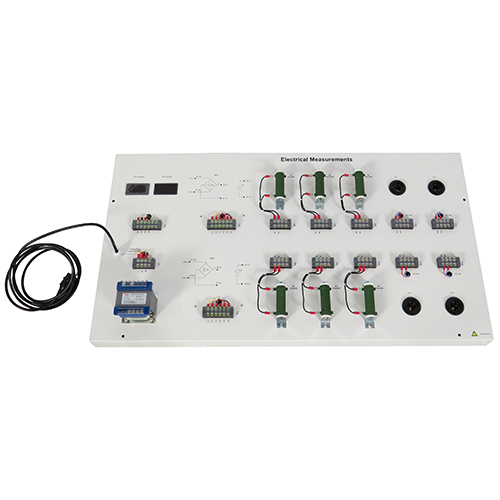
Equipment panel (1 pc): Mounts the motor, terminals, meters, and control elements, and provides a clear wiring diagram for reference.
Equipment power cord (1 pc): Connects the trainer to the single-phase AC 220 V supply.
Single-phase repulsion motor unit (1 pc): The core training object, comprising the stator, rotor, commutator, and adjustable brush assembly.
Brush angle adjustment mechanism (1 set): Allows trainees to shift the brush position and observe changes in torque, speed, and rotation direction.
Measurement module — V / A / W (1 set): Reads line voltage, current, and input power in real time.
Protection and control module (1 set): Includes the main switch, fuse, emergency stop button, and overload relay.
3.2 Accessories
The equipment is supplied with the following accessories:
Red BRV wire, 10 meters — 1 pc
Black BRV wire, 10 meters — 1 pc
Digital multimeter — 1 pc
Electrician tool kit — 1 set
Screwdriver set — 6 pcs
4. Teaching Experiment List
The MR604E supports the following structured experiments:
(1) Basic use of the equipment — Identify all panel components, read the wiring diagram, and perform a safe power-on check.
(2) Structure and disassembly observation of the repulsion motor — Examine the stator winding, salient-pole rotor, commutator segments, and brush gear, and compare them with those of an induction motor.
(3) Principle of repulsion-motor operation — Trace the induced current path in the rotor and explain the repulsion torque mechanism.
(4) No-load starting and running test — Measure starting current, no-load current, and no-load speed, and record the build-up of back EMF.
(5) Effect of brush angle on starting torque and direction — Shift the brush holder through the full range and observe how torque, speed, and rotation direction change.
(6) Loaded performance test — Apply a mechanical load via the dynamometer or brake, and plot torque–speed and current–speed curves.
(7) Power and efficiency measurement — Measure input power with the wattmeter and calculate output power and efficiency at multiple load points.
(8) Speed regulation methods — Compare brush-shift control against supply-voltage control, and discuss the advantages and limitations of each.
(9) Reversing the direction of rotation — Demonstrate reversal by brush-axis shift and by stator-winding interchange.
(10) Common faults and troubleshooting — Simulate brush wear, poor commutation, open rotor coil, and weak spring tension, and practice systematic diagnosis.
(11) Safe maintenance and commissioning — Inspect brushes, clean the commutator, lubricate bearings, and perform a pre-start safety checklist.
5. Why a Repulsion Motor Still Matters in Training
Although single-phase repulsion motors have been largely replaced by inverter-fed induction motors and BLDC drives in new equipment, they remain a cornerstone of electrical-machine education for three reasons.
First, they make armature reaction visible. The adjustable brush axis lets students see how the spatial relationship between stator flux and rotor MMF governs torque — a concept that remains abstract in other motor types.
Second, they teach commutator fundamentals. Understanding commutation, sparking, and brush maintenance is essential for anyone servicing DC motors, universal motors, or legacy industrial drives.
Third, they preserve legacy-system knowledge. Elevators, cranes, compressors, and older machine tools still in service worldwide use repulsion-start or repulsion-induction motors, and trained technicians who understand them are scarce.
The MR604E turns this historically important machine into a safe, measurable, and fully instrumented teaching platform — bridging classic electrical-machine theory with modern practical skills.
1.1 Product Description
The MR604E Single Phase Repulsion Motor is a professional teaching and training device designed for electrical engineering and motor control education. It integrates a genuine single-phase repulsion motor with a comprehensive set of measurement modules, wiring terminals, conversion circuits, and protective components, enabling students to construct, operate, and analyze one of the most distinctive single-phase AC motor topologies.
A repulsion motor is a commutator-type single-phase AC motor that develops torque through the repulsion between the stator magnetic field and currents induced in the rotor winding. By adjusting the brush angle, trainees can directly observe how starting torque, running speed, and direction of rotation change — making the MR604E an ideal platform for understanding commutator motor principles, armature reaction, and speed regulation that cannot be easily demonstrated with ordinary induction motors.
1.2 Product Features
(1) Clear component layout, engineering-grade terminals.
The panel arranges the stator winding, rotor assembly, commutator, brush holder, measurement interfaces, and power terminals in a layout that mirrors real industrial motor control cabinets. Students can quickly complete wiring, debug the circuit, and strengthen practical skills — shortening the gap between classroom theory and hands-on operation.
(2) Integrated measurement and protection units.
The trainer incorporates voltmeters, ammeters, wattmeters, and a digital multimeter interface, covering experiments from basic no-load characterization to loaded performance and brush-angle adjustment. It supports the full teaching sequence: principle recognition, circuit construction, parameter measurement, and performance analysis, all on one station.
(3) Standard electrical design with safety compliance.
Component selection, circuit protection, insulation coordination, and emergency stop follow international electrical safety regulations. Necessary insulation barriers, overcurrent protection, and grounding measures reduce hazards during live training, providing a stable and safe experimental environment.
(4) Compact and portable.
The bench-top form factor minimizes floor space and allows easy relocation between classrooms, laboratories, and off-site training venues.
(5) Realistic industrial simulation.
The trainer reproduces the operating characteristics of historical and legacy repulsion-motor drives still found in elevators, hoists, compressors, and machine tools — giving trainees a close-to-real working environment for maintenance and troubleshooting practice.
(6) Systematic curriculum support.
Accompanying lab manuals cover fundamental motor theory, wiring procedures, measurement techniques, speed-control methods, fault diagnosis, and safe maintenance practices — supporting both beginner and advanced training stages.
2. Technical Specifications
2.1 Basic Technical Parameters
The MR604E operates on a single-phase three-wire AC 220 V / 50 Hz supply. The core training object is a single-phase repulsion motor of the commutator type. It is designed for use in ambient temperatures ranging from −10 °C to +40 °C, with ambient humidity below 85 % at 25 °C (non-condensing). The insulation class is Class B (or as labeled on the nameplate), and the protection degree is IP20, intended for indoor training use.
2.2 Equipment Appearance Parameters
The overall dimensions of the equipment are 1190 mm × 650 mm × 310 mm, and the net weight is approximately 45 kg.
3. Product Components and Functions
3.1 Main Body
The main body of the MR604E includes the following components:
Equipment panel (1 pc): Mounts the motor, terminals, meters, and control elements, and provides a clear wiring diagram for reference.
Equipment power cord (1 pc): Connects the trainer to the single-phase AC 220 V supply.
Single-phase repulsion motor unit (1 pc): The core training object, comprising the stator, rotor, commutator, and adjustable brush assembly.
Brush angle adjustment mechanism (1 set): Allows trainees to shift the brush position and observe changes in torque, speed, and rotation direction.
Measurement module — V / A / W (1 set): Reads line voltage, current, and input power in real time.
Protection and control module (1 set): Includes the main switch, fuse, emergency stop button, and overload relay.
3.2 Accessories
The equipment is supplied with the following accessories:
Red BRV wire, 10 meters — 1 pc
Black BRV wire, 10 meters — 1 pc
Digital multimeter — 1 pc
Electrician tool kit — 1 set
Screwdriver set — 6 pcs
4. Teaching Experiment List
The MR604E supports the following structured experiments:
(1) Basic use of the equipment — Identify all panel components, read the wiring diagram, and perform a safe power-on check.
(2) Structure and disassembly observation of the repulsion motor — Examine the stator winding, salient-pole rotor, commutator segments, and brush gear, and compare them with those of an induction motor.
(3) Principle of repulsion-motor operation — Trace the induced current path in the rotor and explain the repulsion torque mechanism.
(4) No-load starting and running test — Measure starting current, no-load current, and no-load speed, and record the build-up of back EMF.
(5) Effect of brush angle on starting torque and direction — Shift the brush holder through the full range and observe how torque, speed, and rotation direction change.
(6) Loaded performance test — Apply a mechanical load via the dynamometer or brake, and plot torque–speed and current–speed curves.
(7) Power and efficiency measurement — Measure input power with the wattmeter and calculate output power and efficiency at multiple load points.
(8) Speed regulation methods — Compare brush-shift control against supply-voltage control, and discuss the advantages and limitations of each.
(9) Reversing the direction of rotation — Demonstrate reversal by brush-axis shift and by stator-winding interchange.
(10) Common faults and troubleshooting — Simulate brush wear, poor commutation, open rotor coil, and weak spring tension, and practice systematic diagnosis.
(11) Safe maintenance and commissioning — Inspect brushes, clean the commutator, lubricate bearings, and perform a pre-start safety checklist.
5. Why a Repulsion Motor Still Matters in Training
Although single-phase repulsion motors have been largely replaced by inverter-fed induction motors and BLDC drives in new equipment, they remain a cornerstone of electrical-machine education for three reasons.
First, they make armature reaction visible. The adjustable brush axis lets students see how the spatial relationship between stator flux and rotor MMF governs torque — a concept that remains abstract in other motor types.
Second, they teach commutator fundamentals. Understanding commutation, sparking, and brush maintenance is essential for anyone servicing DC motors, universal motors, or legacy industrial drives.
Third, they preserve legacy-system knowledge. Elevators, cranes, compressors, and older machine tools still in service worldwide use repulsion-start or repulsion-induction motors, and trained technicians who understand them are scarce.
The MR604E turns this historically important machine into a safe, measurable, and fully instrumented teaching platform — bridging classic electrical-machine theory with modern practical skills.
Leave a Reply
Your email address will not be published.Required fields are marked. *