By minrry | 02 September 2026 | 0 Comments
Comprehensive Introduction to the MR611E DC-Excited Generator: Principles, Parameters,Structure, a
Comprehensive Introduction to the
MR611E DC-Excited Generator: Principles,
Parameters,Structure, and Teaching Applications
MR611E DC-Excited Generator: Principles,
Parameters,Structure, and Teaching Applications
The MR611E DC-Excited Generator is a frequently used core training device in motor teaching experiments, DC power generation principle training, and electrical control training scenarios. Based on the principle of shunt-wound DC power generation, it features both motor and generator operating modes, a simplified structure, safe operation, and stable parameters, making it ideal for university electrical engineering teaching, laboratory principle demonstrations, and DC power generation characteristic testing. This blog post will comprehensively analyze the core highlights of this device, based on official product information.
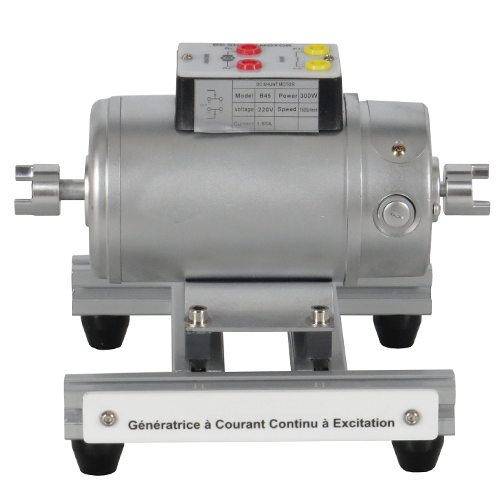
I. Core Product Principle: Shunt-Wound Self-Excited DC Power Generation Architecture
The MR611E DC excitation generator is essentially a shunt-wound self-excited DC generator, one of the most classic models of DC generators.
Its core structural features are quite distinctive: the excitation winding (the core winding used to generate the magnetic field) and armature winding are connected in parallel, unlike series-wound or compound-wound DC generators. This parallel-wound structure gives the equipment more stable no-load characteristics and voltage regulation range, which is also the core reason why it is suitable for teaching voltage regulation experiments.
As a self-excited generator, the equipment does not require an external independent excitation power supply. It relies on its own armature output to power the excitation circuit and autonomously completes voltage build-up and power generation, perfectly replicating the core working logic of traditional DC generators.
II. Core Product Features: Wide-Range Smooth Voltage Regulation
Voltage adjustability is the biggest technical advantage of the MR611E DC excitation generator and the key difference between it and ordinary fixed-voltage generators.
The equipment's excitation winding is connected in series with an adjustable rheostat. During experiments and use, the excitation current of the excitation circuit can be smoothly changed by adjusting the rheostat's resistance value. The precise change in the excitation current directly changes the internal magnetic field strength of the generator, ultimately achieving a wide range of continuously adjustable generator output voltage.
This feature visually demonstrates the correspondence between "excitation current - magnetic field strength - output voltage," perfectly matching teaching scenarios such as DC generator voltage regulation characteristic experiments and load characteristic experiments. Experimental phenomena are clear, and data linearity is excellent.
III. Precise Technical Parameters, Adapted to Standard Teaching Conditions
The MR611E excitation generator features standardized parameters and a lightweight design, adapting to typical laboratory power supply environments. Core parameters are as follows:
1. Power Supply and Operating Parameters
Input Power Supply Specifications: Single-phase two-wire DC 220V ±5%, 50Hz standard operating conditions
Rated Operating Parameters: Rated voltage 220VDC, rated current 1.65A, stable output voltage 220V, rated operating speed 2000rpm
2. Lightweight Design
The entire unit weighs <20kg, is compact, easy to move, requires no special mounting base, and is suitable for desktop training scenarios in laboratories, making setup and storage very convenient.
IV. Dual-Purpose Function: Can Be Used as a Motor or Generator
This MR611E DC excitation generator features bidirectional operation and extremely high functional flexibility:
1. Generator Mode: Driven by mechanical power, it outputs 220V DC voltage through self-excitation, serving as a power supply for experimental loads and various electrical training modules;
2. Motor Mode: After connecting to a corresponding DC power supply, it can operate as a DC motor, used to demonstrate the driving, speed regulation, and torque characteristics of a DC shunt motor.
This single machine enables bidirectional training as both a motor and a generator, significantly enriching experimental projects and maximizing cost-effectiveness and training adaptability. In the entire training system, this equipment primarily serves as the core experimental load, providing stable load conditions for various DC electrical characteristic tests.
V. Equipment Structure and Complete Accessory List
1. Main Core Components
The main structure of the equipment is extremely simple, consisting of two main components: 4 sets of power terminal blocks and 1 generator main unit. The terminal block layout is standardized, compatible with 4mm safety cables, ensuring clear wiring, reducing the risk of short circuits, and guaranteeing safe operation during training.
2. Standard Accessories A complete set of training accessories is included with the product, eliminating the need for additional purchases and ensuring immediate usability:
- Black 4mm safety connecting cables: 2
- Red 4mm safety connecting cables: 2
- Equipment fixing strip: 1 The dedicated safety cables offer excellent insulation and smooth insertion/removal. The fixing strip securely holds the equipment in place, preventing displacement during experiments and enhancing training stability and safety.
VI. Core Teaching Experiment Applications
The MR611E DC excitation generator is a core piece of equipment for electrical automation, motor drives, and power system training. It can perform numerous classic teaching experiments, and all detailed experimental steps can be found in the accompanying experimental manual. Core training projects include: DC shunt generator voltage build-up experiment, excitation current voltage regulation characteristic experiment, generator load characteristic test, and DC motor and generator bidirectional operating condition switching experiment, comprehensively helping learners understand the core principles and practical skills of DC excitation generator generation.
VII. Conclusion
The MR611E DC-Excited Generator, as a high-precision, teaching-grade shunt-wound DC excitation generator, has become a mainstream piece of equipment in motor training laboratories of various universities and colleges due to its self-excited and stable shunt-wound structure, smooth and wide-range voltage regulation performance, flexible dual-purpose functionality, and lightweight and safe design. It not only accurately reproduces the theoretical characteristics of DC power generation but also helps learners thoroughly understand the core knowledge points of excitation voltage regulation, load characteristics, and energy conversion through hands-on experiments. It is an indispensable and high-quality training device in DC motor teaching.
Leave a Reply
Your email address will not be published.Required fields are marked. *